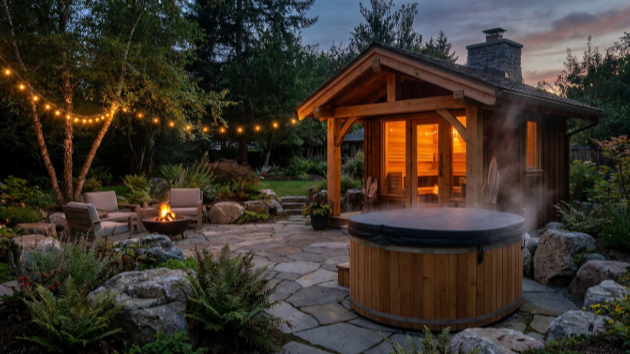
Electric vs Wood Heat for a Sauna: What Each One Actually Costs

Electric sauna heaters cost less upfront, typically $500 to $1,500 for the heater alone, and run 50 cents to a little over a dollar in electricity per session. Wood-fired heaters cost more to buy and install, often $1,200 to $3,000 including chimney work, but per-session fuel cost can be near zero if you already have access to firewood. Which one actually saves you money depends less on the sticker price and more on how often you’ll use it and whether wood is already something you have lying around or something you’d have to buy.
What Does an Electric Sauna Heater Actually Cost to Buy and Install?
A home electric heater in the 6 to 9 kW range, sized for a typical two to four-person cabin, runs $500 to $1,500 for the unit itself. Installation is where costs vary most: if you already have a 240-volt circuit nearby, an electrician might charge $200 to $400 to make the connection. If you need an entirely new circuit run from your panel, that jumps to $500 to $1,500 or more, depending on distance and whether the run is exposed or has to go through finished walls. No venting or chimney is required, which keeps the installation relatively contained compared to a wood-fired setup.
What Does a Wood-Fired Sauna Heater Actually Cost to Buy and Install?
Wood-fired heaters themselves run $800 to $2,500 depending on size and build quality, generally more than a comparable electric unit. On top of that, you need a stovepipe and chimney system that meets local fire clearance codes, which typically adds $400 to $1,000 in materials and labor. There’s no electrical work required, which is a real advantage if your sauna site is far from your home’s electrical panel and running a new circuit would be expensive. All in, a wood-fired install often lands close to or above the all-in cost of an electric setup once chimney work is factored in, even though the heater itself might not be dramatically more expensive.
What Does Each One Cost Per Session Going Forward?
Electric heaters draw grid power the entire time they’re running, which at average US residential electricity rates works out to roughly 50 cents to a little over a dollar for a typical hour-long warm-up and session, depending on your local utility rate and cabin insulation. That cost is predictable and shows up as a line item on a bill you already pay.
Wood-fired sessions cost whatever your firewood costs. If you’re burning wood you cut and split yourself, or scrap from a property you already maintain, the marginal cost per session can be close to nothing. If you’re buying seasoned firewood by the cord, prices vary widely by region, often $200 to $400 a cord, and a sauna session might use a modest fraction of that, still adding up over a season of regular use. The honest answer is that wood-fired heat is cheaper only when the wood itself is cheap or free to you specifically.
What About Time, Not Just Money?
This is the cost most buying guides skip. An electric heater is a switch or a timer: set it, walk away, come back to a ready cabin in 15 to 30 minutes. A wood-fired heater needs a fire built, tended, and fed throughout the session, plus ash cleanup afterward, easily adding 20 to 30 minutes of hands-on time per use beyond the electric equivalent. For someone squeezing a sauna session into a weekday evening, that time cost is often the deciding factor, regardless of what the fuel itself costs. For someone who treats the fire-building as part of the ritual, it’s a feature, not a downside.
What Does Long-Term Maintenance Cost Look Like?
Electric heating elements typically last 5 to 10 years under regular use before they need replacing, a repair that usually runs $150 to $400 including the part. The rocks on top of an electric heater also need periodic replacement, generally every 1 to 2 years, since repeated heating and cooling cracks them, though rocks themselves are inexpensive, often under $50 for a full set.
Wood-fired heaters have their own upkeep: the firebox and stovepipe need periodic cleaning to clear creosote buildup, a safety issue as much as a performance one, and chimney inspection is worth budgeting for annually if you use the sauna often, similar to a wood-burning fireplace. Neither system is expensive to maintain in absolute terms, but wood-fired maintenance leans more toward safety-critical tasks like chimney cleaning, which shouldn’t be skipped even in a year you didn’t use the sauna much.
So Which One Actually Comes Out Ahead?
If you use your sauna several times a week and want predictable, low-hassle heat, electric wins on total cost of ownership for most households, mainly because the fuel cost is small and stable and the time cost is near zero. If you have a reliable, cheap wood source and you use the sauna less frequently, or you specifically want the wood-fired ritual, the economics can tilt the other way, especially over many years once the higher upfront chimney cost is amortized. When comparing specific models, checking installed cost, not just heater price, matters more than the spec sheet suggests. Buyers weighing electric against wood-fired for a specific site can get help from the team at SweatDecks on the electrical or venting requirements before they commit, since that number swings the total cost more than the heater choice itself.
Frequently Asked Questions
Is a wood-fired sauna cheaper than electric long term?
It depends on your access to cheap or free firewood. If you already have a wood supply, fuel cost can be lower, but tending time and higher upfront cost often offset the savings unless you use the sauna very often.
How much does it cost to run an electric sauna heater?
A typical 6 to 9 kW heater costs roughly 50 cents to a little over a dollar per hour-long session at average US residential electricity rates.
Do wood-fired sauna heaters need a chimney?
Yes. They vent through a stovepipe and chimney, adding installation cost and requiring fire-code clearance, unlike electric heaters which need no venting.
Which heats up faster, electric or wood?
Electric heaters typically reach temperature in 15 to 30 minutes. Wood-fired heaters usually take 45 minutes to over an hour, since you’re building and maintaining an actual fire.
References
- “Clinical Effects of Regular Dry Sauna Bathing: A Systematic Review.” Evidence-Based Complementary and Alternative Medicine, 2018. https://pubmed.ncbi.nlm.nih.gov/29849692/
- “Does the Combination of Finnish Sauna Bathing and Other Lifestyle Factors Confer Additional Health Benefits? A Review of the Evidence.” Mayo Clinic Proceedings, 2023. https://pubmed.ncbi.nlm.nih.gov/37270272/
- “Effects of heat and cold on health, with special reference to Finnish sauna bathing.” American Journal of Physiology, 2018. https://pubmed.ncbi.nlm.nih.gov/29351426/
- Underwriters Laboratories. https://www.ul.com/